0%
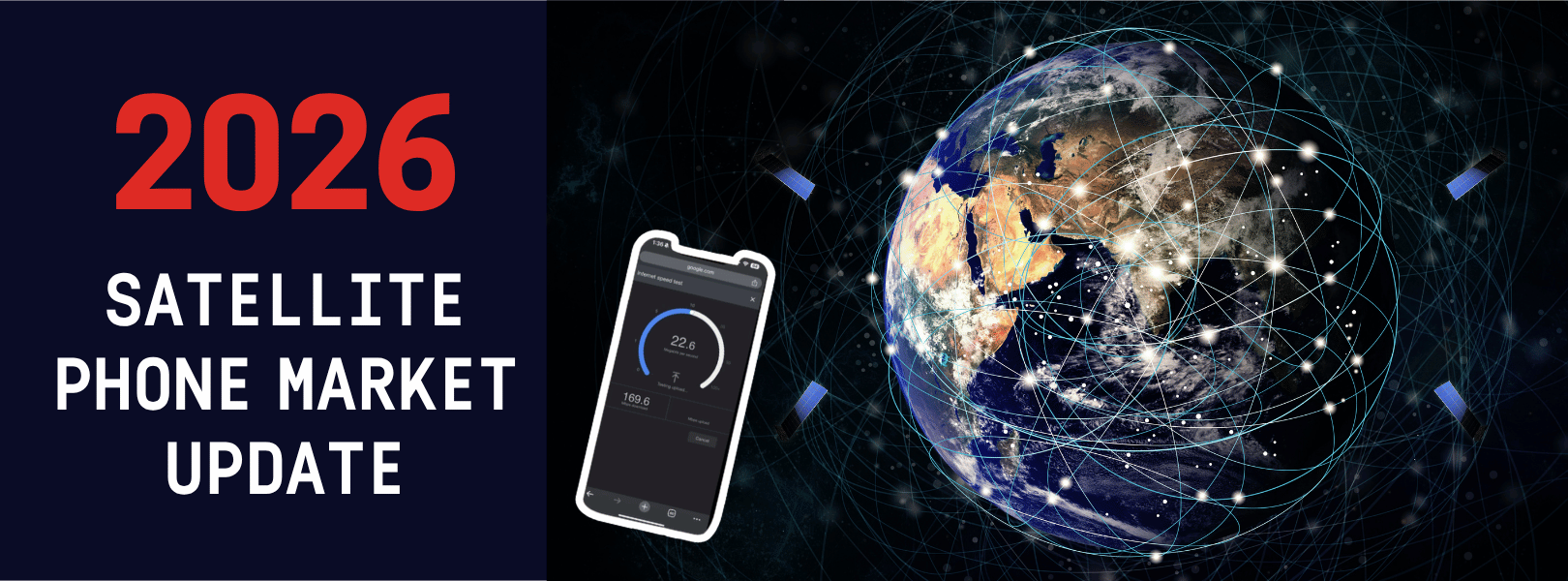
You're 80 miles into the backcountry. Your phone has five bars on the lock screen — five bars of nothing. The cell tower stopped 60 miles back. Until recently, that meant your phone was a flashlight with a camera. In 2026, that's changing fast. And the changes are not as simple as the headlines make them sound.
The numbers tell the first half of the story. The global direct-to-cell market is projected to hit $7.6 billion this year, a 49% jump over 2025, according to TrendForce. Starlink officially launched Starlink Mobile at MWC 2026 — text, voice, and video, riding on more than 10,000 V2 satellites in low Earth orbit. T-Mobile, Verizon, Virgin Media O2 in the UK, Telstra in Australia — all running on Starlink rails. Apple has been pushing emergency texts through Globalstar since the iPhone 14 in 2022. The new Samsung Galaxy S26 and Google Pixel 10 ship with satellite SOS out of the box. Want to compare current Starlink Mobile service plans? They're up.
So is the dedicated satellite phone dead? No. Not even close. And here's the part the marketing teams skip.
The Gap Between the Marketing and the Mountain
Ookla, the network testing firm, recorded direct-to-device satellite connections growing 25% between July 2025 and March 2026. But the same data shows only 0.46% of US smartphone users actually connected to a satellite in March 2026. Less than half of one percent. The capability is in millions of pockets — almost nobody is using it, and most who try will find it's text-only when they need it most.
When you're caught in a whiteout in the Wind River Range, "limited messaging service" via your iPhone is not a rescue tool. It's a coin toss. The Iridium 9555 connects to a 66-satellite constellation that covers every square mile of the planet, including both poles. The Iridium Extreme has a physical SOS button you can press with frozen gloves. The Iridium GO! sits on your pack strap and turns your smartphone into a real satellite device. None of these care if Starlink has spectrum in your country. None of these need a tower handshake. They just work.
The Industry Is Consolidating — Fast
The shake-up is real. Starlink dropped $17 billion to buy EchoStar's spectrum in September 2025. Viasat absorbed Inmarsat — making the Inmarsat IsatPhone 2 part of the new combined entity. SES bought Intelsat. Eutelsat merged with OneWeb. Lynk Global folded into Omnispace. The legacy operators — the ones who built the infrastructure that has saved sailors and climbers for 30 years — are pivoting to enterprise and government work.
Iridium CEO Matt Desch told Payload Space that low-cost launches give SpaceX a 30% structural advantage on every business case. He's not wrong. But Iridium also signed Iridium NTN Direct partnerships with Syniverse and Deutsche Telekom this spring. Iridium is still selling the one thing Starlink cannot easily replicate: pole-to-pole, decades-proven, every-square-mile coverage. The full Iridium satellite phone lineup tells the story.
What This Means for People Who Actually Go Off-Grid
If you live in a city and you take a road trip through the Sierras twice a year, your iPhone's emergency SOS is probably enough. Pack it, register your medical info, and trust the Globalstar bird.
If you fish offshore, sail a passage, climb above 10,000 feet, work in the bush, or live somewhere a hurricane can erase the grid for two weeks — a smartphone with "satellite messaging" is a backup, not a primary. You want a real handset on a real network, with a real SOS button.
The industry is moving. The capability is spreading. None of that changes the basic equation when the weather turns and the tower goes silent. Preparation isn't paranoia. It's the reason you make it back.
Ready to gear up? Shop satellite phones or call our team. We have inventory in hand when others are back-ordered.
Sources:
- TrendForce (Apr 27, 2026);
- The Register/Ookla (Apr 21, 2026);
- Via Satellite (Apr 7, 2026);
- Payload Space (Apr 8, 2026);
- Research and Markets (Jan 22, 2026);
- GSA Report (Feb 2026);
- Techlicious (Mar 19, 2026).