0%

The foundational assumption of modern business—ubiquitous, reliable connectivity—is increasingly challenged. We've seen operations shut down for days just because of a lost cell signal or internet outage. That’s when we realized: providing reliable communication is everything. It's not just about cool tech; it's about operational resilience, safeguarding your people, and protecting your core business functions.
Here's the honest breakdown of what you need to know about satellite phones and why they remain a non-negotiable component of any serious continuity plan:
1. A Satellite Phone Is Not Your Smartphone – And That's Its Strength.
Let’s start with the obvious: Starlink is not a satellite phone. While smartphones connect to terrestrial cell towers and Starlink offers phenomenal high-speed internet, a dedicated satellite phone is purpose-built for one core mission: reliable voice communication when everything else fails. It doesn't need Wi-Fi, has its own long-lasting battery, and operates independently of ground infrastructure.
2. Your Ultimate Emergency Lifeline.
An emergency satellite phone is your absolute lifeline in crisis scenarios. It boots up in under a minute, ready to establish a voice call from anywhere on Earth. This instantaneous, reliable connection is critical for coordinating emergency response and ensuring employee safety.
3. True Global Coverage: LEO vs. GEO.
The ability of a global satellite phone to connect from anywhere depends on its network. We primarily work with two distinct architectures:
-
Iridium (LEO): The Iridium network, with its 66 cross-linked Low Earth Orbit (LEO) satellites, provides 100% global coverage from pole-to-pole. This makes an Iridium phone the only option for operations in polar regions, offering low latency for clear voice quality. Activating it requires a dedicated Iridium service plan designed for this network.
-
Inmarsat (GEO): The Inmarsat network uses geostationary (GEO) satellites, providing highly stable coverage over approximately 99% of the Earth's surface, excluding the extreme poles. An Inmarsat phone is favored for its high signal stability, particularly in maritime and industrial use, and must be paired with a compatible Isat phone service plan.
4. The IsatPhone 2: A Rugged Workhorse.
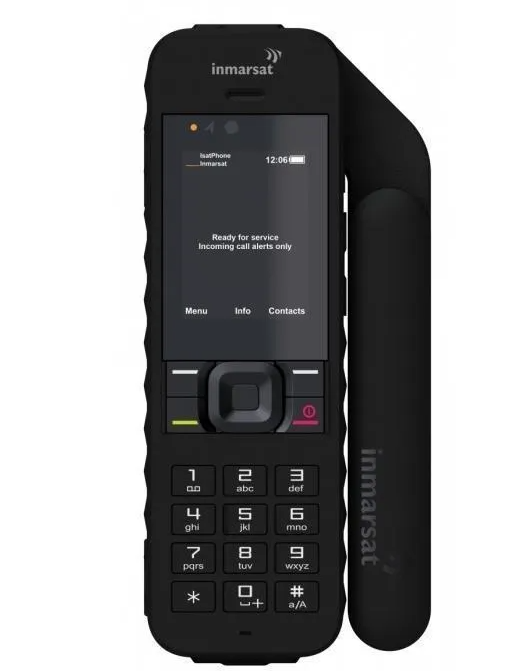
The IsatPhone 2: A Rugged Workhorse. The IsatPhone 2 is a durable device with an IP65 rating, making it dust-tight and resistant to water jets. Its exceptional battery life offers up to 8 hours of talk time and 160 hours of standby, ideal for extended field use.
5. The Iridium 9575 Extreme: Global Reach, Integrated SOS.
For missions demanding absolute global reach, the Iridium 9575 Extreme is the benchmark. It matches the IsatPhone 2's durability with an IP65 rating and meets military-grade ruggedness standards (MIL-STD 810F). It also includes a dedicated, programmable SOS button to transmit GPS coordinates to an emergency response coordination center.
6. Iridium GO! exec: Portable Voice & Data Hotspot.
The Iridium GO! exec is a compact, portable hotspot, also rated IP65, that creates a local Wi-Fi bubble. This allows multiple users to make two simultaneous satellite voice calls and access a small IP data channel sufficient for critical data applications like WhatsApp messaging or sending small email reports. It’s about enabling crucial lightweight digital communication on the move beyond basic voice.
7. How to Choose the Best Satellite Phone.
The best satellite phone for you depends entirely on your mission. Consider where you'll be (polar regions, mountains, open sea) and your primary need (pure voice, some data, team coordination). Our deep inventory means we can match the right hardware to the right job.
8. Decoding Satellite Phone Plans.
Satellite phone plans come in various forms:
-
Monthly Plans: Ideal for regular use, offering predictable budgeting, US-based phone numbers, rollover minutes, and lower per-minute costs.
-
Prepaid Plans: Best for occasional use, short trips, or as an emergency satellite phone backup in a go-bag. You buy a block of minutes with a specific validity period.
9. The Value of Rollover Minutes.
Rollover minutes allow you to keep unused airtime from one month and add it to the next, preventing loss of what you’ve paid for. This is typically an add-on feature for a small monthly fee and is essential for maximizing the value of your plan.
10. The US-Based Phone Number Advantage.
A USA phone number add-on makes it easier and cheaper for people in the US to call your sat phone. Standard satellite numbers are international, often costly or blocked for callers. This feature routes directly to your satellite phone, deducting minutes from your plan allowance.
11. To Buy or To Rent? That is the Question.
or occasional use, a satellite phone rental can be a cost-effective solution, starting as low as $34.99/wk for Globalstar or $44.99/wk for Iridium. If you need a satellite phone for more than a month a year or multiple times annually, it's often more economical to buy a satellite phone outright.
12. Starlink Rentals for High-Speed Data.
While not a satellite phone, Starlink offers revolutionary high-speed, low-latency internet. If your team needs robust data for video calls, cloud apps, or large file transfers in remote areas, Starlink rental options, including bundles with portable power solutions, are available for land-based mobility and maritime use.
13. Unused Minutes: Use 'Em or Lose 'Em (Mostly).
If you're on a plan without rollover, unused minutes typically expire at the end of each month. The 100-minute plan often includes rollover, and it's also available as a $10/month add-on for other plans. Expert Tip: If your usage is unpredictable, the rollover add-on pays for itself by preventing lost airtime.
14. Who Else Uses Satellite Phones?
Beyond individual adventurers, our clients include global enterprises for executive protection and disaster recovery, aid organizations in austere environments, mining operations, utility companies in hurricane zones, insurance, banking, and pharmaceutical firms. The military also widely employs these devices.
15. What Satellite Phone Does the Military Use?
Military and first responders frequently utilize robust Iridium phone models like the 9575 Extreme, which meets military-grade ruggedness standards (MIL-STD 810F). Iridium PTT (Push-to-Talk) devices also provide secure, one-to-many communication for team coordination, often with AES-256 encryption.
16. Garmin inReach vs. Satellite Phone: Voice is Key.
Devices like Garmin inReach are excellent satellite messengers, providing text and SOS capabilities, but they are not full sat phones. A dedicated satellite phone provides actual voice communication, which is paramount in many emergency and operational scenarios. There's no substitute for a real conversation when details matter.
17. Weather Resilience: L-Band's Advantage.
The IsatPhone 2 operates on L-band frequency, which performs remarkably well in adverse weather conditions like heavy cloud cover or rain. This is a significant advantage over some higher frequency satellite services that can be impacted by "rain fade."
18. Minimal Latency for Clear Conversations.
Modern sat phones offer surprisingly good call quality with low latency. The IsatPhone 2, for instance, has less than a second of latency, typically around 700 milliseconds, which ensures clear conversations between different locations.
19. Indoor Connectivity is Possible (with Accessories).
While satellite phones require a direct line of sight to orbiting satellites, indoor service is achievable with external antennas and docking stations. Devices like the SkyLink 5100 can even route two Iridium phone lines into a facility via Ethernet, allowing up to 16 smartphones to register and make calls over the satellite network using VoIP apps.
20. Proactive Monitoring for Readiness.
Advanced systems like the SkyLink 5100 include proactive monitoring capabilities, often via a secondary LTE connection. This allows administrators to check device status, battery health, and network registration at any time, eliminating the common "closet full of dead batteries" problem in disaster preparedness.
21. Direct-to-Cell Services: A Glimpse of the Future, Not a Present Replacement.

Starlink's Direct-to-Cell service aims to provide text messaging directly to standard 4G LTE phones. While revolutionary for basic communication in dead zones, it is currently text-only. Voice and data are on the roadmap but not yet a reliable replacement for a dedicated satellite phone.
22. Contract Requirements and ETFs.
Many monthly satellite phone plans, particularly those bundled with a free phone, typically come with early termination fees (ETFs). These agreements are designed for long-term value, as most customers maintain service for many years.
23. Flexibility to Purchase Without Service.
You can buy satellite phone hardware without an active minute plan, though activation (provisioning) will take 24-48 hours when you're ready to use it. We always recommend active, pre-provisioned devices for immediate use, especially in critical situations.
24. Competitive Pricing on Satellite Phones for Sale.
We offer a comprehensive selection of satellite phones for sale, along with competitive satellite phone plans. For example, the IsatPhone 2 can often be acquired at no additional cost with our popular 100-minute monthly plan.
25. Expert Support When You Need It Most.
At Satellite Phone Store, we don't just sell equipment; we provide the expertise to ensure your communication solution is ready when it matters most. Our team is available 24/7 with same-day delivery options for critical emergency communications.
In a world that is simultaneously more connected and more vulnerable, the question for any critical organization is no longer if its traditional systems will fail, but when. The truly vital question is whether your organization is merely hoping for connectivity, or if it has proactively designed, tested, and built a true capability for uninterrupted operations. We are here to help you build that robust, resilient communication framework.
Now that you know the essential tips for using a sat phone, use our quick guide to finding the best satellite phone for your specific adventure.