0%
You land in Delhi after sixteen hours in the air. You're headed for the Himalayas, and you packed right: boots, layers, water filter, and an Iridium tucked in the side pocket of your pack in case a trail washes out. The customs officer runs your bag through the scanner. He stops it. He pulls the phone out, turns it over in his hand, and calls his supervisor.
That phone was your lifeline. In India, it's evidence.
This is the part of trip planning most people skip. They research coverage, battery life, and airtime. They never ask the one question that can land them in a detention room: is a satellite phone legal where I'm going? In most of the world, yes. But in a short list of countries, carrying one can cost you the device, a fine, a court date, or your freedom.
We pulled this list together from current U.S. government security reports, embassy alerts, and news on new laws passed in 2025. This is our 2026 satellite phone restricted countries list: where the law stands, what changed since last year, and how to stay connected without breaking it.

The Short Answer: Where Satellite Phones Are Illegal in 2026
We sort countries into two groups. Treat them very differently.
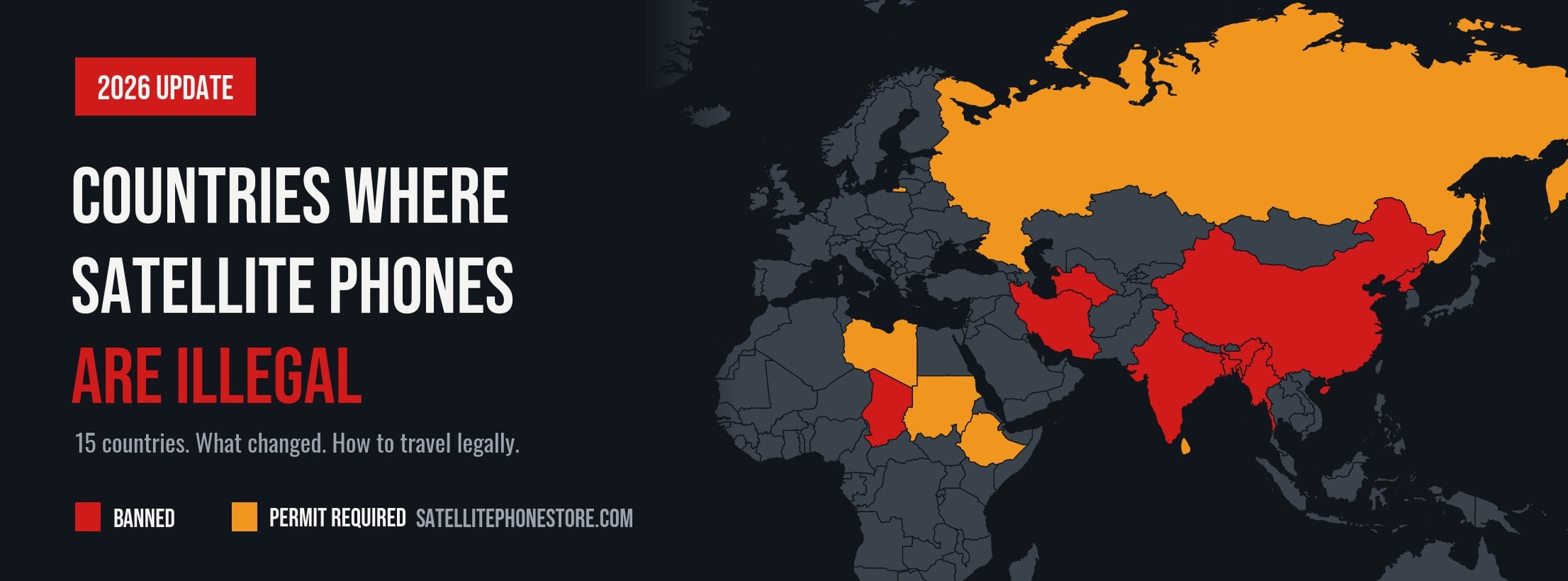
Banned or effectively banned (red). Don't bring a satellite phone. If a permit exists at all, it's reserved for governments, aid groups, or security work, and you shouldn't count on getting one as a traveler.
Permit or registration required (orange). You can bring one, but only with paperwork filed before you fly. Show up without it and expect the phone to be seized at the airport.
What Changed for 2026
Laws move. Lists online don't. A lot of the sat phone "banned country" lists still floating around date back to 2017, and some of them are flat wrong today. Here's what we changed.
Removed: Nigeria
Nigeria showed up on almost every older list. That ban came from 2013, when the army shut down communications in Borno State during the fight against Boko Haram. It was regional, and it was never a national law. The U.S. government's Overseas Security Advisory Council (OSAC) said it plainly in its August 2025 country report: "There are no reported restrictions on the use or importation of satellite phones." Nigeria comes off our map.
That doesn't mean Borno is a place to wave a sat phone around. It means the law, nationally, doesn't ban it.
Added: Iran
In 2025, Iran's parliament banned the use, purchase, sale, import, and supply of unlicensed internet communications equipment, Starlink included. The penalty is six months to two years in prison, plus confiscation. In April 2026, Iranian authorities arrested two foreigners in Jolfa for importing satellite internet equipment.
The law targets satellite internet first. But if you're carrying any satellite device into Iran without a license, you are carrying exactly what that law was written for. U.S. sanctions also keep American providers from serving Iran. Leave it home.
Added: Nicaragua
OSAC lists satellite phones in Nicaragua as illegal and subject to confiscation. Add the State Department's Level 3 "Reconsider Travel" advisory, which warns of arbitrary enforcement of laws and wrongful detention, and this is not a country to test.
Added: Turkmenistan
OSAC's October 2025 security report: possession and use of satellite phones are illegal without prior, specific government permission. That permission is not a tourist visa add-on.
Added: Ethiopia (permit)
Travelers need written permission from the Ministry of Communication and Information Technology to bring a sat phone in. Phones that don't run on the state network can be held at customs.
Moved to permit: Libya
Older lists put Libya alongside North Korea because of a 2011 crackdown on Thuraya phones. OSAC's March 2025 report says sat phones are "permitted but require registration with the authorities." That's a paperwork problem, not a prison problem. Do the paperwork.
India: The One That Catches the Most Travelers
If you searched "satellite phone India" to find out whether you can bring one, here's the answer: not without government permission. India gets its own section because it's the country where we hear the most horror stories, and because it's a top destination for trekkers, climbers, and pilgrims heading into the mountains.
In January 2025, the U.S. Embassy in India issued a travel alert: satellite phones and certain GPS devices are prohibited, and travelers carrying them may face detention, fines, or arrest. OSAC has documented arrests, court appearances, fines, and confiscations of travelers' phones, including U.S. citizens. India's official customs notice says it is "illegal to use/carry Thuraya or other such satellite phones in India."
Two things trip people up:
- It's not just phones. The embassy alert names "certain GPS devices." If you carry a two-way satellite messenger like a Garmin inReach or a Bivy Stick, assume it can be treated the same way. Check before you pack it.
- "I didn't know" won't save you. OSAC says it directly: ignorance of the law is not an acceptable defense.
The only legal route is advance permission from India's Department of Telecommunications. Get it in writing before you fly, or leave the satellite phone home.
If you're searching for a "satellite phone price in India" or trying to buy a satellite phone in India for a trip there, stop and read the alert first. Owning one legally in your home country doesn't make it legal at an Indian airport.
Why Are Satellite Phones Illegal in Some Countries?
It comes down to control. A cell phone runs through towers the government licenses, monitors, and can switch off. A satellite phone skips all of that. It talks straight to a satellite overhead and routes your call through a ground station somewhere else on the planet.
To a government that shuts down the internet during protests, that's a hole in the fence. The reasons we see over and over:
- Surveillance. Calls can't be tapped through local networks.
- Security fears. Militants have used sat phones to plan attacks. That's what drove the Borno ban in Nigeria and the bans in Chad.
- Internet shutdowns. Iran passed its law after Starlink terminals kept people online during blackouts.
- Telecom revenue. Some countries want all traffic on the state carrier.
None of these reasons have anything to do with you. Doesn't matter. The customs officer enforces the law, not your intentions.
Starlink and Satellite Messengers Count Too
The rules were written for sat phones, but a lot of countries now cast a wider net. A Starlink Mini, an Iridium GO! exec, a satellite messenger: to a customs officer looking at a scanner screen, it's all satellite gear.
Iran's 2025 law is the clearest example. It names satellite internet outright. India's alert pulls in GPS devices. If a country is red on our map, assume every device in your bag that talks to a satellite gets the same treatment as a phone.
How to Travel With a Satellite Phone Without Getting Arrested
You don't have to pick between legal and safe. You just have to plan ahead. Here's the routine we tell every customer heading overseas.
- Check the destination and every layover. A connection through a restricted country can put your phone in front of customs. If your bag gets rerouted or you overnight, you're in their jurisdiction.
- Read the embassy page and the latest OSAC country report. They're free, current, and written for exactly this question.
- File permits early. Russia, Sri Lanka, Sudan, Libya, and Ethiopia all want paperwork before arrival. Carry printed copies, not just a screenshot on a phone with a dead battery.
- Declare it. Hidden gear looks like you meant to hide it. Declared gear with a permit looks like what it is: safety equipment.
- Know which network your phone uses. Some permit systems only approve certain networks. Ethiopia's state carrier works with Thuraya. Older Indian rules allowed only Inmarsat with permission. A permit for one network doesn't cover another.
- For red countries, don't bring it. Plan your safety around local options instead: a local SIM, a registered guide service, check-in schedules with someone at home.
Which Device to Bring When It Is Legal
Most of the planet allows satellite phones. If you're going to Alaska, Patagonia, the Australian outback, or open ocean, the question isn't legal, it's which phone fits the trip.
- Pole-to-pole trips, open ocean, high latitudes: Iridium Extreme 9575. Iridium is the only network with true global coverage, poles included. The Extreme has a dedicated SOS button you can hit with gloves on, GPS location sharing, and an IP65 rating against dust and rain.
- Most land trips away from the poles: Inmarsat IsatPhone 2. Inmarsat's satellites sit over the equator, so you need a clear view of the sky toward the equator. Deep canyons and dense forest can block it. In the open, it's solid and simple to use.
- One trip, not a lifetime: Rent a satellite phone. It ships activated with airtime, and you send it back when you're home. For a two-week trek, renting usually beats buying.
- Text-based check-ins and SOS: two-way satellite messengers like the Bivy Stick. Lighter, cheaper airtime, and great for "I'm at camp, all good" messages. Same legal rules apply in restricted countries.
- Backup for emergencies only: a PLB. No subscription, no screen, one job: send your position to rescue services.
Not sure which network covers your route? Call us. We carry the biggest satellite inventory in the business, so when other shops are back-ordered before peak season, we usually have the gear on the shelf and can ship it activated.
FAQ
The two questions we hear most from people at home are "are satellite phones illegal in US states?" and "are satellite phones illegal in UK?" The answer to both is no. Here's that, and the rest.
Are satellite phones illegal in the US?
No. Satellite phones are legal to buy, own, and use in the United States. Iridium, Inmarsat, Globalstar, and Thuraya phones sold by authorized dealers carry FCC authorization.
Are satellite phones illegal in the UK?
No. Satellite phones are legal to own and use in the United Kingdom. The usual travel rules apply on the way out: check your destination and any layover countries before you fly.
What countries are satellite phones illegal in?
As of 2026, satellite phones are banned or effectively banned in India, China, North Korea, Cuba, Iran, Bangladesh, Myanmar, Chad, Nicaragua, and Turkmenistan. Russia, Sri Lanka, Sudan, Libya, and Ethiopia allow them only with a permit or registration filed before arrival.
Why are satellite phones illegal in some countries?
Satellite phones connect directly to satellites, bypassing local networks the government controls and monitors. Countries ban them over surveillance, security fears tied to militant groups, internet shutdowns, and protecting the state telecom carrier.
What happens if I bring a satellite phone into a country where it's banned?
At minimum, customs seizes it. In India, OSAC has documented arrests, court appearances, and fines for travelers, including U.S. citizens. In Iran, the 2025 law carries six months to two years in prison. Don't gamble on a warning.
Can I use a satellite phone in an emergency in a restricted country?
Many providers will connect an emergency call no matter where you are. That doesn't make possession legal. The phone still has to get through customs, and using it can still get you charged. Plan for emergencies through legal local channels instead.
Do these rules apply to Starlink and satellite messengers?
Often, yes. Iran's 2025 law names satellite internet equipment like Starlink. India's 2025 embassy alert covers certain GPS devices. If a country restricts satellite phones, treat any satellite device the same way until you confirm otherwise.
Is this list final?
No list is. Laws change, and enforcement varies by airport and by officer. Use this as a starting point, then confirm with the embassy and the current OSAC country report before every trip. See our restricted countries map for the latest version.
Sources
- U.S. Embassy India: Satellite Phones and GPS Devices Prohibited in India (Jan. 2025)
- OSAC: Guide for Overseas Satellite Phone Usage (2021)
- OSAC: Nigeria Country Security Report (Aug. 2025)
- OSAC: Libya Country Security Report (Mar. 2025)
- IranWire: Iran Criminalizes Starlink Use (Jul. 2025)
- WANA: Starlink in Iran (Oct. 2026)
- The News: Iran Arrests Two Foreigners Over Starlink Device Imports (Apr. 2026)
- U.S. State Department: Nicaragua Country Information
The Bottom Line
A satellite phone is the thing you pack so that a broken ankle, a capsized boat, or a washed-out road doesn't turn into a missing-person report. But the best lifeline in the world does you no good sitting in a customs evidence locker while you sit in a holding room.
Ten minutes of checking before you fly is all it takes. Look up your destination. Look up your layovers. File the permit or leave the phone home. Preparation isn't paranoia. It's smart.