0%
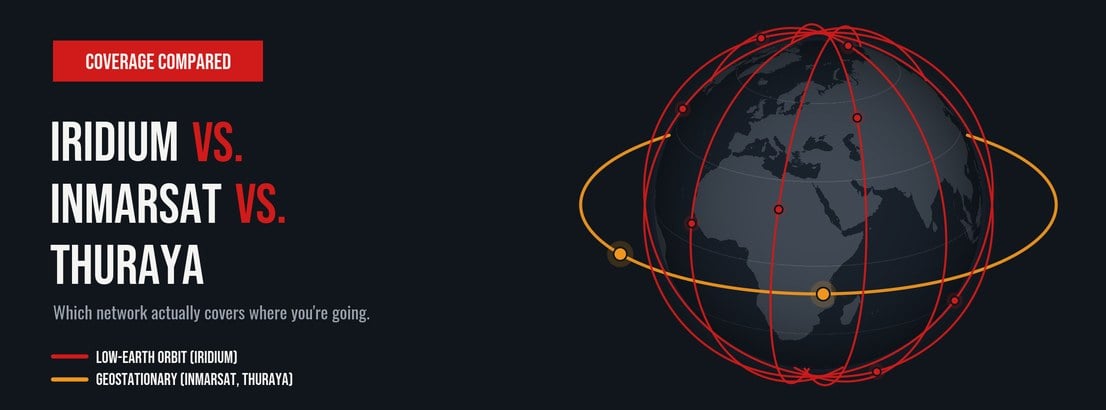
The map on the box says global. The map that matters is the one over your head at three in the morning.
You are anchored in a fjord north of the Arctic Circle. The wind has swung around and the anchor is dragging toward rock. You pull the sat phone out of the ditch bag, power it on, and stare at the screen. No bars. The phone is fine. It just can't see the satellite it was built for, because that satellite is parked 22,000 miles over the equator and the mountain behind you is in the way.
That is the whole satellite phone coverage problem in one scene. Every network calls itself "global" or "near-global." Every one of them has a place where it goes quiet. The question isn't which phone is best. It's which network covers the exact ground, water, or ice you will be standing on when things go wrong.
I've carried Iridium, Inmarsat, Thuraya, and Globalstar handsets in the rain, on boats, and in country where the nearest cell tower was a day's drive away. Here is the straight Iridium vs. Inmarsat vs. Thuraya comparison, including where each one fails.
The three networks (in short)
Iridium flies 66 cross-linked satellites in low-earth orbit, about 485 miles up, running pole to pole. It is the only satellite phone network with true pole-to-pole coverage. It's US owned and operated, and trusted by the US government. If you don't know exactly where the trip will take you, this is the safe pick.
Inmarsat, now owned by Viasat, uses geostationary satellites parked over the equator. Its IsatPhone 2 is the lowest-cost rugged global voice handset you can buy, and it handles voice, SMS, SOS, and GPS. It covers almost everything except the high polar latitudes. The catch: you need a clear line of sight toward the satellite's fixed spot in the sky.
Thuraya, now part of UAE-based Space42, is a regional network. It is the best choice for Africa, the Middle East, and much of Asia, and it also reaches Europe and Australia. It does not cover the Americas. Full stop.
Iridium: the only true pole-to-pole option
Iridium satellites don't sit still. They circle the planet about every 100 minutes in six orbital planes that meet over the poles. Each satellite is cross-linked to its neighbors, so your call can hop across the constellation in space before it comes down to a ground station. That's why Iridium works in the middle of the Southern Ocean, on the Greenland ice cap, and at the North Pole itself. No other handheld network can say that.
Field lesson one: the satellites move. If you're under thick canopy or down in a slot canyon and can't get a signal, wait. Another satellite will cross your patch of open sky, often within a few minutes. With a geostationary network, if the satellite's spot is blocked, it stays blocked until you move.
Field lesson two: Iridium runs on L-band, which handles rain far better than the higher frequencies used by satellite internet dishes. A downpour won't kill your call. A wall of wet granite will.
The trade-off is bandwidth and cost. Iridium handsets are built for voice, text, and light data, not web browsing. If you need email and weather files, look at the Iridium GO! exec hotspot, which turns your smartphone into the screen and keyboard. Iridium hardware and airtime also tend to cost more than the alternatives. You are paying for the coverage map.
The handset I hand people who are going somewhere serious is the Iridium Extreme 9575. Physical buttons you can work with gloves on. A dedicated SOS button under a cover so it doesn't fire in your pocket. Built to MIL-STD 810F and rated IP65 against dust and water jets. It gives you about 4 hours of talk time and up to 30 hours of standby, which is a night and a day of waiting with the phone on. Pack a spare battery.
Who should buy Iridium: polar expeditions, blue-water sailors crossing oceans, pilots, anyone whose route crosses the Arctic Circle or runs south of 60 degrees, and anyone who honestly doesn't know where the trip will end up. Browse Iridium satellite phones and Iridium service plans.
Inmarsat, now owned by Viasat: lowest-cost rugged global voice
Inmarsat's satellites sit in geostationary orbit, about 22,236 miles above the equator. They don't move relative to the ground. That is both the strength and the weakness.
The strength: the IsatPhone 2 is the lowest-cost rugged handset that works across most of the planet. It does voice, SMS, GPS location sharing, and has a programmable assistance button. Viasat rates it at up to 160 hours of standby and up to 8 hours of talk time. That standby figure is close to a week with the phone on and waiting for a call back. It's also simple. If you're buying a phone for someone who will touch it once a year, in a panic, simple matters.

The weakness is look angle. A geostationary satellite holds one fixed spot in the sky. From the lower 48, that spot is to the south, partway up. The farther north you go, the lower it sits. Past about 70 degrees it is skimming the horizon, and in the far polar regions it is gone. Viasat itself says the IsatPhone 2 covers "all but the most polar latitudes." Believe them.
Terrain does the same thing. In a deep canyon, on the north face of a ridge, or tucked into a fjord with a cliff to the south, the phone can show zero bars while the sky straight above you is wide open. The fix is to move: climb out, cross the valley, get a clear look toward the satellite. When you're hurt, "move" may not be an option. Think about that before you buy.
For marine readers: Inmarsat also carries legacy L-band services like Fleet Broadband and Swift, which are often kept aboard vessels and aircraft because they are built in for regulatory compliance. If your boat already runs Inmarsat gear, an IsatPhone 2 keeps everything on one network. High-speed data at sea is a separate service, Fleet Xpress, and a separate conversation.
Who should buy Inmarsat: budget-minded buyers working in the lower 48, Mexico, Central and South America, Africa, Europe, and mid-latitude oceans. Home and truck emergency kits. Anyone who values battery life over polar coverage. Browse Inmarsat satellite phones.
Thuraya: the regional specialist
A Thuraya satellite phone is the one I'd want in my pack for a trip across the Sahel, the Arabian Peninsula, or the Central Asian steppe. Its geostationary satellites put their capacity over Africa, the Middle East, Europe, Asia, and Australia. Inside that footprint, Thuraya is strong and usually cheaper to run than Iridium.
The network now sits under Space42, and it is investing. Newer Thuraya terminals push data up to 1 Mbps, and its touchscreen handsets combine satellite with 4G cellular in one device. Use the local network in town, switch to satellite when the towers fade. For an aid worker or contractor moving between a capital city and remote field sites, that is one phone instead of two.
Now the warning. Thuraya does not cover North America or South America. Buy a Thuraya satellite phone in the US to use in the US and you own a paperweight. It is also geostationary, so the same look-angle rules apply inside its footprint: you need a clear view toward the satellite.
Who should buy Thuraya: travelers, NGOs, and crews working inside Africa, the Middle East, and Asia who don't need polar or Americas coverage. See Thuraya service plans.
What about Globalstar?
Globalstar comes up in almost every conversation, so here's a straight answer. Globalstar flies low-earth-orbit satellites, but they don't link to each other in space. Your call bounces straight down to a ground station within range of the satellite overhead. Near a ground station, which covers most of the lower 48 and southern Canada, call quality is excellent and airtime is among the cheapest around. Far from one, in mid-ocean, the high Arctic, and large parts of Africa and Asia, coverage thins out or disappears. It's a solid domestic backcountry phone. It is not an ocean-crossing phone. Details on the Globalstar network.
Side-by-side comparison
| Iridium | Inmarsat (Viasat) | Thuraya | Globalstar | |
|---|---|---|---|---|
| Coverage | Entire planet, pole to pole | Near-global, no high polar latitudes | Europe, Africa, Middle East, Asia, Australia. No Americas | Strong near ground stations. Gaps mid-ocean, polar, much of Africa and Asia |
| Orbit | Low-earth, cross-linked | Geostationary | Geostationary | Low-earth, relays to ground stations |
| Voice / SMS | Yes / Yes | Yes / Yes | Yes / Yes | Yes / Yes |
| SOS on handset | Yes (Extreme 9575) | Yes (IsatPhone 2 assistance button) | On select handsets | No dedicated button on GSP-1700 |
| Data | Light data; GO! exec hotspot for email | Light data; BGAN terminals for broadband | Up to 1 Mbps on newer terminals | Light data |
| Sky view needed | Open sky in any direction; satellites move | Clear line toward a fixed satellite | Clear line toward a fixed satellite | Open sky plus a ground station in range |
| Handset cost | $$$ | $ | $–$$ | $ |
| Airtime cost | $$$ | $$ | $$ | $ |
| Best for | Polar, ocean, aviation, unknown routes | Budget global voice, emergency kits | Africa, Middle East, Asia | North American backcountry |
| Hard limit | Higher cost, slow data | High latitudes and terrain to the south | No Americas coverage | Gaps far from ground stations |
*Cost bands are relative. Check current pricing on each product page.
Pick by where you are going
Open ocean
Iridium. In the Iridium vs. Inmarsat debate offshore, Inmarsat does cover most mid-latitude ocean, and plenty of coastal cruisers run it happily. But once you are crossing oceans, the boat is rolling and you can't always hold a clear line to one fixed spot in the sky. Iridium's moving satellites forgive a lot. Pair it with an EPIRB registered to your vessel. The sat phone lets you talk to rescuers. The EPIRB tells them exactly where to come.
High latitude and polar
Iridium. That's not a preference, it's the only answer. Alaska's North Slope, Svalbard, Greenland, the Southern Ocean, Antarctica. Geostationary satellites sink toward the horizon up there and then vanish below it.
Mountains and canyons

Iridium has the edge because its satellites move. Inmarsat works well on summits, open ridges, and slopes facing the equator, but it struggles in deep valleys and on north faces. If your route lives in slot canyons or tight drainages, buy Iridium or plan to climb to a clear spot to make your call.
Africa and the Middle East
Thuraya is the specialist here and usually the cheapest to run. Iridium works too, with no gaps. Inmarsat covers the region. Before you pack any of them, check the law: some countries restrict satellite phones, require a permit, or ban them outright. Getting caught at customs can mean confiscation or worse. Read our Guide for Overseas Satellite Phone Usage before you fly.
Domestic North American backcountry
You have options. Globalstar is cheap and clear across most of the lower 48. Inmarsat is dependable for hunting camps, ranches, and emergency kits as long as you have a view to the south. Iridium works everywhere, including the Brooks Range and the high Canadian Arctic. Thuraya does not work here at all.
Where each network genuinely fails
This is the section most sellers skip. Read it before you spend money.
Iridium fails when you bury it. Inside a building, under heavy wet canopy, deep in a narrow slot: no line to the sky, no call. Waiting helps because the satellites move, but it isn't magic. Iridium also costs more to buy and run, and its data is slow. If a cheaper network covers your trip well, Iridium may be more phone than you need.
Inmarsat fails at high latitudes and behind terrain. If the slice of sky toward the equator is blocked by a ridge, a cliff, a building, or a stand of tall trees, you are done until you move. That's not a defect. It's physics. But it means an Inmarsat phone at the bottom of a deep canyon is a bet you shouldn't make.
Thuraya fails the moment you leave its footprint. There is no coverage in the Americas, and inside the footprint it carries the same look-angle limits as Inmarsat.
Globalstar fails far from its ground stations: mid-ocean, the high Arctic, and large parts of Africa and Asia.
Rain is less of a threat than people think. All four handset networks use L-band or S-band, and those frequencies handle rain far better than satellite internet dishes do. Heavy rain rarely drops a sat phone call. Dense, dripping foliage overhead is the bigger problem.
Every network has the same ground rule: a sat phone is a radio, and it has to see the sky. Step outside. Get away from walls and overhangs. Extend the antenna and hold it straight up. A lot of "my sat phone doesn't work" problems get fixed right there.
The short answer
- Going anywhere and everywhere, crossing oceans, or heading for the poles: Iridium.
- Rugged global voice at the lowest cost, and you'll stay out of the high Arctic and deep canyons: Inmarsat IsatPhone 2.
- Working in Africa, the Middle East, or Asia: Thuraya.
- Staying in North America on a budget: Globalstar.
Still not sure? Tell us where you're going. We'll tell you which network covers it, and if the cheaper option is wrong for your trip, we will say so. We keep the gear in stock and ready to ship, so you won't be stuck on a back-order with a departure date bearing down. Start with our satellite phone buyer's guide.
Preparation isn't paranoia. It's knowing, before you leave, that when you press the button, something up there is listening.
Frequently asked questions
Which satellite phone network has the best coverage?
Iridium. It is the only satellite phone network with true pole-to-pole coverage, including both poles and every ocean. Inmarsat comes close but does not cover the high polar latitudes.
Does Iridium work at the North Pole?
Yes. Iridium's satellites fly near-polar orbits that meet over both poles, so coverage there is excellent. Geostationary networks like Inmarsat and Thuraya cannot reach that far north.
Does Inmarsat work everywhere?
Almost. Inmarsat covers most of the planet but not the far polar regions, and it needs a clear line of sight toward a satellite fixed over the equator. Deep canyons, north-facing slopes, and tall obstacles in that direction can block it.
Which satellite phone works in Africa?
Thuraya, Iridium, and Inmarsat all cover Africa. Thuraya is the regional specialist and often the cheapest to use there. Iridium covers the whole continent with no gaps. Check local laws first, because some countries restrict satellite phones.
Can a satellite phone work under trees?
Sometimes. Light cover is usually fine. Dense, wet canopy can block the signal. With Iridium, waiting a few minutes often helps because the satellites move overhead. With Inmarsat and Thuraya, you will usually need to move to a clearing with a view toward the satellite.