


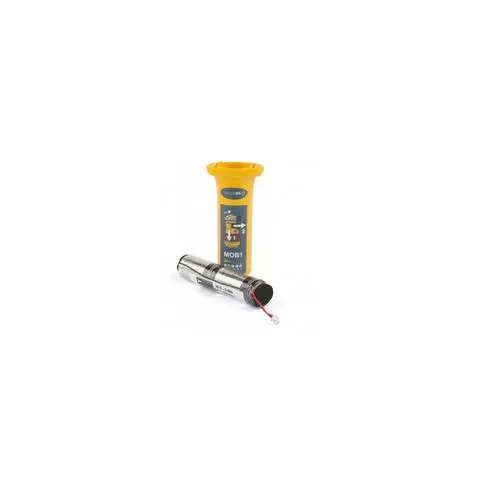

ACR RescueME MOB1 Personal AIS Beacon 741S-01776
Description
AIS Position Reporting
When activated, the MOB1 uses its internal GPS receiver to determine the wearer’s position and broadcasts that location on the two international AIS channels. Nearby vessels equipped with a compatible AIS receiver or AIS-enabled chartplotter can see the MOB target and track its updated position during the recovery.
The unit transmits eight AIS messages per minute. These include position reports and MOB status messages, helping the crew maintain an electronic reference even if visual contact is lost. Actual receiving range depends on antenna height, sea conditions, surrounding vessels, and the receiving equipment.
DSC Alerting to the Vessel
A compatible version of the MOB1 can be programmed with the vessel’s nine-digit MMSI number. Following activation, it can send an individual distress relay to the programmed DSC-equipped VHF radio, helping draw the crew’s attention to the man-overboard event.
DSC operation depends on the country in which the beacon is used and the capabilities of the vessel’s radio. Some older radios may not respond to the MOB1 distress relay, and certain DSC functions may be restricted or disabled under local regulations.
Automatic Life-Jacket Activation
The MOB1 is designed to mount inside a compatible inflatable life jacket using the supplied oral-tube bracket and activation tape. When correctly installed and armed, inflation of the life jacket pulls away the activation slide, deploys the antenna, and switches on the beacon automatically. The first transmissions begin approximately 15 seconds after activation.
Manual activation remains available if the beacon is carried separately or if automatic deployment does not occur. Life-jacket compatibility and installation instructions should be confirmed with the life-jacket manufacturer before fitting the device.
Strobe and Position Indication
An integrated high-intensity strobe flashes during operation to provide an additional visual reference for the recovering vessel. This is useful at night, in reduced visibility, or when waves make it difficult to maintain sight of a person in the water.
The indicator light also communicates operating status. It flashes red while the beacon is acquiring a position and changes to green once valid GPS position data is available.
Battery and Routine Testing
The sealed lithium battery has a seven-year storage life and supports more than 12 hours of operation at -20°C, with more than 24 hours considered typical under normal conditions. The battery must be replaced after emergency activation or before its marked expiration date. Battery replacement and internal servicing should be completed through an approved service provider.
The MOB1 includes functional, AIS, GPS, and DSC test procedures. Testing should follow the manufacturer’s recommended schedule because excessive testing reduces the available battery capacity.
Local Recovery Device
The MOB1 is intended primarily to alert and guide the vessel from which the person has fallen, along with other AIS-equipped vessels in the immediate area. It does not directly notify a rescue coordination center or emergency satellite system.
For offshore operations where direct satellite alerting is required, it may be carried alongside an appropriate 406 MHz personal locator beacon rather than used as a replacement for one.
Technical Specifications
Dimensions
- Dimensions: 13.4 × 3.8 × 2.7 cm / 5.28 × 1.50 × 1.06 in.
- Width over mounting bracket: 5.9 cm / 2.32 in.
Weight
- 92 g / 3.25 oz
Durability
- Water resistance: Tested at 2 bar for more than 60 minutes
- Operating temperature: -20°C to 55°C / -4°F to 131°F
- Storage temperature: -30°C to 70°C / -22°F to 158°F
- Humidity testing: 93% relative humidity at 40°C / 104°F
- Hard-surface drop testing: 1 m / 3.3 ft. on six sides
- Water-drop design test: 20 m / 65.6 ft.
- US approval: FCC 47 CFR Part 95K
- Canada approval: RSS-287 for AIS operation
- Additional compliance: UK Radio Equipment Regulations, EU Radio Equipment Directive and applicable Australia/New Zealand standards
- Application: Marine emergency use
Included
- Ocean Signal rescueME MOB1 Personal AIS Beacon
- Oral-tube life-jacket mounting bracket
- Life-jacket activation tape
- Activation-slide protective cover
- Antenna rewind tool
- Programming adapter
- Safety tether cord
- User documentation
Battery
- Battery type: Sealed lithium-metal battery
- Storage life: 7 years
- Operating life: More than 12 hours at -20°C / -4°F
- Typical operating life: More than 24 hours
- Battery replacement: Required after emergency use or before the marked expiration date
Additional
- Product type: Personal AIS man-overboard beacon
- Brand: Ocean Signal, an ACR Group brand
- Model: rescueME MOB1
- Part number: 741S-01776
- Activation: Automatic with compatible inflatable life jackets or manual
- Initial transmission: Approximately 15 seconds after activation
- Visual signal: Integrated high-intensity strobe
- Vessel MMSI programming: Supported on DSC-enabled versions
- Self-identification number: Factory-programmed AIS MOB identity beginning with 972
- Warranty: 2 years, extendable to 5 years after eligible product registration
Data Network
- Positioning: Integrated GPS
- AIS transmit frequencies: 161.975 MHz and 162.025 MHz
- AIS transmit power: 1 W EIRP
- AIS data rate: 9,600 baud
- AIS messages: Message 1 position report and Message 14 MOB status
- AIS transmission rate: 8 messages per minute
- DSC transmit frequency: 156.525 MHz
- DSC transmit power: 0.5 W EIRP
- DSC data rate: 1,200 baud
- DSC message: Individual distress relay
- DSC repetition: Once every five minutes
- Approximate AIS range: Up to 5 miles, depending on conditions and receiving equipment
