0%
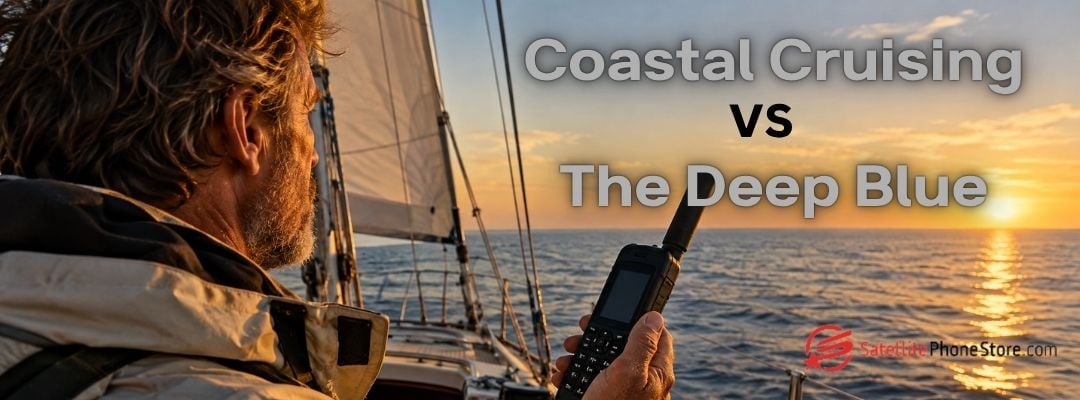
You're 40 miles out. The cell bars went to zero an hour ago. The wind is building from the wrong direction, and you need to reach someone on shore. What happens next was decided back at the dock: which network you picked, which phone you packed, and how much airtime you loaded...
Where you sail decides which satellite phone you need. A day run past cell range and a three-week ocean crossing ask very different things of a network, a handset, and an airtime plan. Get the combination wrong and you find out at the worst possible moment.
Most boaters already know a satellite phone works on the water. The harder questions are which device, which plan, and how many minutes you actually need for a day trip versus a long passage. This guide answers those. You'll see how coastal and bluewater sailing differ, how the main voice networks compare at sea, which safety features matter, and how to size airtime so you're not overpaying or running dry mid-passage.
Key takeaways
- Coastal cruisers use a satellite phone as the backup line for when VHF and spotty cell coverage run out. A regional or geostationary network may cover your waters, but check the coverage map for your exact route first.
- Bluewater and high-latitude sailors rely on the phone as their primary voice link to shore. Iridium's 66 cross-linked satellites cover the planet pole to pole, which makes it the default for ocean crossings and polar routes.
- Long calls on mid-latitude routes suit a geostationary handset like the Inmarsat IsatPhone 2. It talks to a satellite that holds a fixed spot in the sky, so there are no satellite-to-satellite handoffs during the call.
- Starlink and a satellite phone do different jobs. Starlink is broadband that runs on ship's power. A satellite phone is a voice line that runs on its own battery.
- Your smartphone's satellite features aren't built for bluewater. Starlink says its Direct to Cell service covers land, lakes and coastal waters, and native voice calls are still on T-Mobile's roadmap.
- A satellite phone's SOS feature works alongside an EPIRB. It doesn't replace one.
- Size airtime to the passage, not a generic package, and test everything at the dock before you leave.
Coastal vs. bluewater: why the phone's job changes
On a coastal run, your satellite phone is the safety net. You may still catch some cell signal near shore, and VHF handles boat-to-boat and boat-to-shore traffic. The phone earns its place when those fail: a breakdown beyond radio range, a medical problem, or a squall that pushes you farther out than you planned.
Offshore, it's the other way around. Past cell range there's no tower to fall back on. Iridium CEO Matt Desch has put that gap in numbers more than once: by his estimates, cell networks reach only about 10 to 15 percent of Earth's surface. Most of the rest is water. On a bluewater passage, your satellite phone becomes your main voice line to shore, your daily check-in tool, and your emergency lifeline.

Network, hardware and airtime all follow from this split.
How the satellite voice networks compare on the water
The network matters more than the handset, because the network decides where your phone works at all. Here's how the main options stack up for sailors.
LEO vs. GEO: the tradeoff in plain terms

Iridium's satellites orbit close to Earth and move fast, so your call passes from one satellite to the next. Iridium's polar orbits are how it covers the poles, which no geostationary network does. Inmarsat's satellites sit in a fixed spot over the equator, so the handset holds one link for the entire call, and you get the best signal by pointing the antenna toward the equator.
For most US coastal and mid-latitude routes, either network covers you. The choice comes down to how long your calls run and how far you roam. If you want long, stable calls with less chance of a drop, a geostationary phone like the IsatPhone 2 is built for it. If your passage plan includes high latitudes or truly remote ocean, Iridium is the standard.
Weather: why satellite voice holds up in storms
Iridium and Inmarsat both run their voice service on L-band, a lower frequency that holds up in heavy rain and thick cloud. Iridium chose L-band for its user links because it penetrates clouds and storms. Satellite broadband typically runs on higher-frequency Ku- and Ka-band, which is more sensitive to weather. When a squall line rolls over, the voice phone is the link that stays up.
What you can and can't do with satellite data
Satellite phones are voice-first. A handset's data speed is about 2.4 kbps, which is fine for short text-based emails but not for web browsing. A hotspot like the Iridium GO! exec lets your crew use their own smartphones for calls, texts, email and weather forecasts, with speeds of up to 88 kbps down and 22 kbps up. A typical weather forecast download is about 200 KB, so a month of daily forecasts fits inside a small data plan. If you need real broadband for crew video calls, streaming or work, carry a satellite internet terminal such as Starlink alongside the phone.
Handheld, hotspot, or mounted antenna?
Most bluewater boats end up with more than one piece of gear. Here's what each setup does best.
Handheld satellite phone. It's battery-powered, needs no installation, and goes wherever you go, including into the ditch bag. The IsatPhone 2 registers on the network in under 45 seconds. The tradeoff is that a handheld needs a clear view of the sky. Below deck or under a hardtop, the signal will be weak or blocked.
Satellite hotspot. The Iridium GO! exec creates a small Wi-Fi network so the crew can call and message from their own phones. It handles up to two voice calls at once, which helps when more than one person needs to reach shore. It's rated IP65 with its port covers closed and built to MIL-STD-810H.

External antenna and docking station. Mount an antenna on the arch, pushpit or rail and run the cable to a dock at the nav station, and you can call and download weather from below deck. On a long passage, this is the setup that keeps you out of a wet cockpit at 3 a.m. Marine setups exist for each of the main handsets:
- Iridium Extreme 9575: the Marine Standard Package pairs the phone with a SatStation Extreme dock, a marine mast antenna and cable.
- Inmarsat IsatPhone 2: the Beam IsatDock2 Marine is an Inmarsat-certified, IP54-rated dock that runs on 10–32V DC and works with an external antenna.
- Iridium GO! exec: the Marine Bundle adds an external dual-mode Iridium/GNSS antenna, a stainless-steel mast or rail bracket, and 5 m of LMR-400 cable.
Mount the antenna as high as you practically can, with a clear view of the sky.
Accessories worth packing
- External antenna kit and dock for below-deck use (see above).
- A DC charging cable for the boat's 12V system, so you can charge without running the generator.
- A solar charger or portable power station as backup if the boat's electrical system goes down.
- A spare battery. The 9575, 9555, IsatPhone 2 and GO! exec all have replacement batteries available.
- A waterproof hard case or dry bag, even for a rated handset.
If you also want broadband aboard, Starlink's maritime hardware is built for permanent installation and in-motion use on vessels. Remember that it runs on ship's AC or DC power, needs a clear view of the sky, and needs a calling app or VoIP service to place calls. It works alongside your phone. It doesn't replace it.
Emergency features every sailing satellite phone should have
Routine check-ins are nice. The real reason to carry the phone is emergencies.
A dedicated SOS button. Not every satellite phone has one, so check before you buy.
- The Iridium Extreme 9575 has a programmable, GPS-enabled SOS button under a protective cover. Pressing it sends your GPS coordinates and a distress message to emergency responders through the GEOS monitoring service.
- The Inmarsat IsatPhone 2 has a dedicated SOS feature that sends a distress signal with your GPS coordinates to a monitoring center, plus an assistance button that sends your location to preset contacts.
- The Iridium GO! exec has a built-in GPS for its SOS function and supports 24/7 SOS monitoring through a third-party emergency response coordination center (IERCC).
- The Iridium 9555 does not have a dedicated SOS button or GPS. It's a solid voice phone, but if one-touch SOS matters to you, choose the 9575.
However your phone handles SOS, register your emergency contacts and set up the response service before you leave the dock.
Satellite phone SOS vs. EPIRB. An EPIRB is a battery-powered radio transmitter designed for one job: sending a distress signal on 406 MHz to the international Cospas-Sarsat search-and-rescue satellite system. Category I units release automatically from their bracket and float free if the boat sinks. A satellite phone adds what an EPIRB can't give you, which is a two-way voice line. You can tell rescuers what's wrong, how many are aboard, and what you need. The two work together, and offshore sailors carry both.
GPS position sharing. The Iridium Extreme 9575 supports online tracking, so family or your shore team can follow the passage. The IsatPhone 2 offers location tracking and can send your GPS coordinates on demand. The Iridium GO! exec doesn't track on its own. Tracking requires an add-on DataHub, and those position reports count against your data plan.
Why your smartphone's satellite features aren't enough. Direct-to-cell services now let some ordinary smartphones text, and use a short list of approved apps, through satellites. In the US, T-Mobile sells Starlink's version as T-Satellite. It supports texting, text-to-911 and data for select apps, and T-Mobile says native voice calling is on its roadmap. Starlink describes its Direct to Cell coverage as working on land, lakes and coastal waters. Open ocean isn't on that list. For a passage, you still want a dedicated satellite phone that makes a direct voice call from anywhere on your route.
Durability: what IP ratings mean for sailors
Salt spray, humidity and a pitching deck kill electronics that were fine on land. Check the rating before you buy.
- IP65 means dust-tight and protected against water jets from any direction: rain, spray and deck wash. Treat it as the practical minimum for use on deck.
- IP67 adds protection against temporary immersion, up to 1 meter deep. That buys time if the phone goes into the bilge or over the side and you get it back fast.
- Shock and ruggedness ratings (IK or MIL-STD-810) tell you how well a phone handles drops on deck or a fall off the chart table.
How the main marine options rate:
- Iridium Extreme 9575: IP65, built to MIL-STD-810F for dust, shock and vibration.
- Inmarsat IsatPhone 2: IP65 and IK04, and it operates from -4°F to +131°F.
- Iridium GO! exec: IP65 with port covers closed, and MIL-STD-810H.
- Thuraya X5-Touch: IP67 and MIL-STD-810G, though it's an option only inside Thuraya's coverage area.
No rating makes a phone saltwater-proof for good. Rinse it with fresh water after spray, dry the charging port before you plug in, and keep it in a waterproof case or dry bag.
Battery life, in sailing terms
- IsatPhone 2: up to 8 hours of talk time and 160 hours of standby. That's close to a week on standby without a charge.
- Iridium Extreme 9575: up to 4 hours of talk time and 30 hours of standby, which is a bit over a day. Plan your charging around that.
- Iridium GO! exec: up to 6 hours of talk or data time.
How many minutes do you actually need?
The phone is a one-time purchase. Airtime is what you pay for every month or every season, so size it to how you really sail.
Estimate from your passage plan
Start with three numbers: how many calls a day, how long each call lasts, and how many days you'll be past cell range. For example, two 5-minute check-in calls a day on a 20-day crossing comes to 200 minutes of voice, before you count any texts, emails or weather downloads. A coastal cruiser who only needs the phone for emergencies and the odd check-in will use far less.
Then add a buffer. Weather can keep you out longer than planned, and that's exactly when you'll want to call more.
Prepaid vs. monthly plans
- Prepaid suits seasonal sailors who use the phone heavily during a passage window and store it the rest of the year. Prepaid minutes expire, so match the card to your season. Iridium prepaid cards on our site run from 14-day validity up to 24 months, depending on the bundle.
- Monthly plans suit full-time cruisers and charter operators who need the line active year-round with a predictable bill. Iridium monthly plans run on 12- or 24-month contracts, with an early termination fee if you cancel early. Rollover minutes are available as an add-on, and unused minutes are forfeited if you cancel service. Calls are billed in 1-minute increments.
Check the Iridium and Inmarsat IsatPhone plan pages for current minute bundles and rates. If you can't decide, our specialists will help you size the plan to your passage.
Pre-departure checklist

A satellite phone only helps if it works when you need it. Run through this before you leave the dock.
- Activate the phone and service well before departure, not the night before.
- Make test calls and send a test text from your slip.
- Register your SOS emergency contacts and set up the response service. Confirm each contact knows their role.
- Test reception from the cockpit, under the dodger and below deck (with the external antenna, if fitted). Note where the signal is strongest.
- Share a check-in schedule with someone on shore, plus what to do if you miss one.
- Save key numbers in the phone: shore contacts, your marina and emergency services.
- Pack your charging gear: DC cable, solar or portable power backup, and a spare battery.
- Stow the phone in a waterproof case, and decide who carries it to the ditch bag.
- Sailing to another country? Check its rules on satellite phones before you arrive. Some countries ban them outright. India prohibits possession of satellite phones, with penalties of up to three years in prison. Others, like China, require a permit. Check the US State Department's travel advisory for each country on your route, and ask your provider.
Get the right phone for your route
Start with one question: where do you sail? Coastal cruisers inside a network's footprint have more hardware and plan options. Bluewater sailors crossing oceans or heading to high latitudes need Iridium's pole-to-pole coverage and gear built for the marine environment. Either way, judge every phone on three things: coverage for your actual route, an IP65 or better rating, and SOS with GPS position.
Satellite Phone Store has been in business since 2006 and carries phones, hotspots and service across Iridium, Inmarsat, Thuraya and Globalstar. That means we can match the phone to your route instead of steering you to one brand. Our specialists will help you choose a device, size your airtime, and get set up before you leave the dock.
Preparation isn't paranoia. It's seamanship.
Talk to a satellite phone specialist: call 1-877-943-6383 (24/7/365) or use our contact form.
Browse: satellite phones and marine satellite terminals.
FAQs about satellite phones for sailing
What's the best satellite phone network for offshore sailing?
For ocean crossings and high latitudes, Iridium. Its 66 cross-linked satellites cover the globe pole to pole. For mid-latitude routes where you want long, steady calls, a geostationary Inmarsat handset like the IsatPhone 2 is also a strong option.
Do I need a satellite phone if my boat has Starlink?
We recommend both if you depend on the boat for your safety. Starlink gives you broadband, but it needs ship's power, a clear view of the sky, and a calling app or VoIP service to place calls. A satellite phone runs on its own battery and makes a direct voice call with no Wi-Fi or dish.
Will my smartphone's satellite texting work offshore?
Don't count on it. Starlink describes its Direct to Cell service as covering land, lakes and coastal waters, and open ocean isn't on that list. In the US, T-Mobile's T-Satellite supports texting and data for select apps, and native voice calls are still on its roadmap. For a passage, carry a dedicated satellite phone.
Can I use one satellite phone for both coastal and bluewater sailing?
Yes, if it's on a network that covers your full range. An Iridium phone works on any route. A regional network phone may lose coverage once you head offshore, so check its coverage map before you buy.
What's the difference between a satellite phone's SOS button and an EPIRB?
A satellite phone's SOS sends your GPS position and a distress alert to a monitoring service, and the phone also lets you talk directly to rescuers. An EPIRB sends a one-way distress signal on 406 MHz to the Cospas-Sarsat search-and-rescue system. Offshore sailors carry both.
How many minutes do I need for a long passage?
Multiply your daily calls by their length and by the number of days offshore, then add texts, weather data and a buffer. Two 5-minute calls a day for 20 days is 200 minutes of voice alone.
What IP rating should a satellite phone have on a sailboat?
IP65 is a sensible minimum for use on deck. It covers dust, rain and spray. IP67 adds protection against temporary immersion up to 1 meter. Keep any handset in a waterproof case.
Will my satellite phone work below deck?
Usually not on its own antenna. Satellite phones need a clear view of the sky. For below-deck calls, fit an external antenna with a docking station, or use a hotspot with its antenna mounted outside.