0%
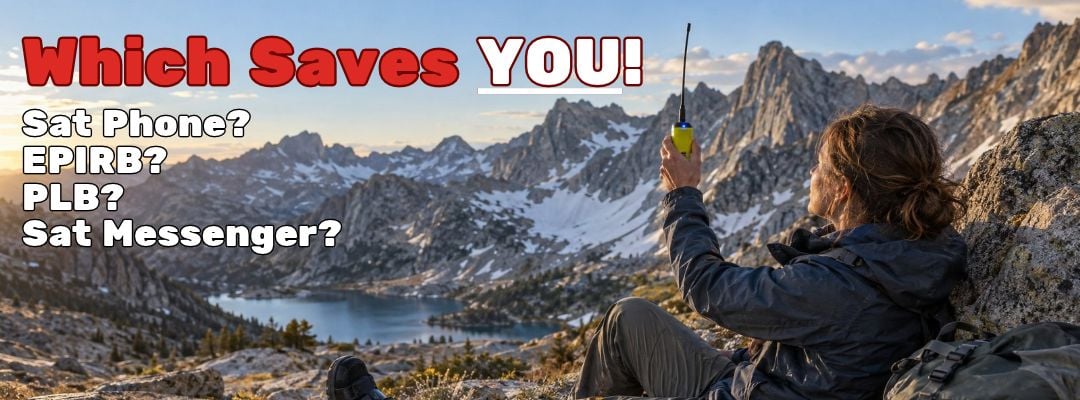
A PLB does one thing perfectly. It tells rescuers exactly where you are. It cannot tell them what happened to you.
You are solo on a ridge in the Wind Rivers. You slipped crossing a late-season snowfield, and your lower leg is bent in a way legs don't bend. Your phone says "No Service." Your partner bailed two days ago. The device in your pack, and whether you registered it, decides how the next twelve hours go.
That's the real question behind PLB vs EPIRB, satellite messenger, or sat phone. It isn't which one is "best." It's which one gets the right help to you, with the right information, before the weather or the bleeding wins. I have carried all four in the mud, the rain, and the open ocean. Here is how they actually differ, and what I tell people to buy.
Four devices, four different jobs
People lump these together as emergency communication devices. They do very different jobs, and the help they summon comes from different places.
| Device | What it does | Who receives the alert | Subscription required | Two-way | Cost to own |
|---|---|---|---|---|---|
| PLB | One-button distress alert with your GPS position | Cospas-Sarsat system, then national rescue authorities | No | No (RLS models confirm your alert was received) | One-time purchase |
| EPIRB | Distress alert built for a vessel; floats, transmits longer, some activate automatically | Cospas-Sarsat system, then the Coast Guard | No | No (RLS models confirm receipt) | One-time purchase, more than a PLB |
| Satellite messenger | Two-way text, tracking, check-ins, SOS | Private 24/7 emergency coordination center | Yes | Text | Device plus a service plan |
| Satellite phone | Voice calls, SMS, GPS, SOS on many models | Anyone you can dial, plus SOS services | Yes (airtime) | Voice and text | Highest device cost plus airtime |

Now the details that matter in the field.
PLB vs EPIRB: the government rescue route

PLBs and EPIRBs use the international Cospas-Sarsat satellite system. When you activate one, it sends a 406 MHz distress signal with your GPS position. In the United States, that alert goes to NOAA's mission control center, which passes it to the Coast Guard at sea or the right rescue coordination center on land. There are no recurring fees, ever. You buy it, register it, and it sits ready for years.
Both also broadcast a 121.5 MHz homing signal that rescue crews use to close in during the last stretch. Newer models add Return Link Service (RLS). A blue light flashes to confirm the Cospas-Sarsat system received your alert. When you're lying in the rocks waiting, that blue light means more than any spec on the box.

So what's the difference between a PLB and an EPIRB?
- Who it's registered to. An EPIRB is registered to a vessel. A PLB is registered to a person.
- How long it transmits. An EPIRB has to transmit for at least 48 hours. A PLB has to transmit for at least 24.
- How it activates. Category I EPIRBs release from their bracket and switch on automatically when they hit the water. Category II EPIRBs are manual. PLBs are always manual.
- Size. An EPIRB lives on the boat. A PLB rides on your shoulder strap, your belt, or your PFD.

Two real examples from our shelves:
The ACR ResQLink 410 RLS weighs 148 grams (5.2 ounces), floats without a pouch, and runs more than 24 hours once activated. Its battery has a five-year replacement interval. That's a full day and night of transmitting while you wait for a helicopter.
The ACR GlobalFix V6 EPIRB transmits for at least 48 hours even at -4°F, carries a 10-year battery replacement interval, and lets you check battery life and self-test history from your phone over NFC. Two nights in a life raft, still sending your position.
The limit: these are one-way. Rescuers know where you are and that you need help. They don't know if you have a sprained ankle or a punctured lung, how many people are with you, or whether you can walk. They also need a clear view of the sky to get your position.
Satellite messengers: two-way text, tracking, and SOS
A satellite messenger adds a conversation. You can text family, send check-ins, share a live track, pull weather, and press SOS. Most run on Iridium, which covers the entire planet.
- The Garmin inReach Mini 3 runs on Iridium, routes SOS to Garmin Response, carries an IP67 rating, and gets up to 350 hours of battery in 10-minute tracking mode. That's two weeks of breadcrumbs on one charge.
- The ZOLEO Satellite Communicator pairs with your phone, runs on Iridium, has an IP68 rating, and gets more than 200 hours of standby. Its SOS and check-in buttons work even if your phone is dead.
- The ACR Bivy Stick runs on Iridium with SOS monitoring by Global Rescue and adds group messaging for crews.

Here's what you need to know before you buy one. A messenger requires an active subscription to do anything over satellite. Let the plan lapse and that SOS button is a piece of plastic.
Also know where your SOS goes. A messenger's SOS goes to a private coordination center, which then contacts local search and rescue. That works well. But each service has its own terms. For example, the Bivy Stick's rescue support through Global Rescue is offered on a fee-for-service basis. Read the terms on your plan before the trip, not after the helicopter.
SPOT vs satellite phone
SPOT gets its own section because it's the device people most often confuse with a phone.
The SPOT Gen4 runs on the Globalstar network. It has buttons for SOS, Check In, Help, and custom preset messages, plus tracking. SOS goes to FocusPoint International's coordination center. It runs on four AAA batteries you can buy at any gas station, and it's IP68 rated.
But the Gen4 sends one-way. It can tell people you're OK or that you need help. It can't hear back from them. And Globalstar coverage thins out mid-ocean, in the high Arctic, and across large parts of Africa and Asia.
So SPOT vs satellite phone comes down to this. SPOT is a tracker that can call for help. A satellite phone is a conversation. For a weekend hiker in the lower 48 who wants family to see the track, the SPOT Gen4 is simple, cheap to run, and fine. For an ocean crossing or a trip where you may need to talk a rescuer through what's wrong, get a phone.
Satellite phones: when you need to talk
Some emergencies can't be handled in 160 characters. A compound fracture. Chest pain at altitude. A disabled engine and a decision about whether to call a tow or the Coast Guard. You need your own voice, and you may need a doctor's voice back.
Which is the best satellite phone? It depends on where you'll be.
- The Iridium Extreme 9575 runs on the only truly pole-to-pole network, US-owned and operated. It has a dedicated SOS button, an IP65 rating, and up to 30 hours of standby and about 4 hours of talk. You can work its buttons with gloves on.
- The Inmarsat IsatPhone 2 is the lowest-cost rugged handset for global voice, SMS, an assistance button, and GPS, with up to 160 hours of standby. It covers everywhere except the far poles but needs a clear view toward the equator.
A satellite messenger vs satellite phone comes down to this: text and tracking on a lower-cost plan, or voice and the ability to explain a complex situation. Many serious users carry both. For the coverage details, see our Iridium vs. Inmarsat vs. Thuraya comparison.
What about a satellite walkie talkie?
If you run a crew, look at Iridium Push-to-Talk. It works like a satellite walkie talkie, one button to talk to your whole group, with talkgroups that can be thousands of miles apart. The Iridium Extreme PTT opens a talkgroup session in under two seconds, encrypts traffic with AES 256, and switches back to a regular phone with an SOS button in phone mode. It's built for search teams, field crews, and expeditions, not solo hikers. See Iridium PTT plans and our satellite radios.
Emergency communication devices for hiking, boating, and disasters
Here is how I'd set people up in the five situations I see most.
| Scenario | Primary device | Backup | Why |
|---|---|---|---|
| Solo hiker or hunter | PLB (ResQLink 410 RLS) | Messenger (inReach Mini 3 or ZOLEO) | No fees, guaranteed government response; messenger adds check-ins and lets you explain |
| Offshore boat crew | EPIRB (GlobalFix V6) | Iridium sat phone plus a PLB on each crew member | EPIRB marks the vessel; the phone handles everything short of sinking; PLBs cover a person overboard |
| Family disaster kit | Satellite phone | Messenger | When cell towers fall, you need to call family and insurers. A PLB is only for life-threatening distress |
| Remote work site | Iridium PTT or sat phone | Messenger for tracking | Crews need group voice; supervisors need to see where everyone is |
| International travel | Iridium sat phone | PLB registered in your home country | Iridium covers everywhere; check local laws on sat phones before you fly |
For disaster planning, see our hurricane preparedness guide.
What most serious users actually carry

A locator plus a communicator. That's the setup I see on almost every serious boat and expedition.
The locator is the floor. It's the device that works when everything else has failed. It needs no plan and no phone, and it calls a government rescue system. The communicator, messenger or phone, handles everything above the floor: telling people you're running late, getting a forecast, describing an injury, calling off a search you no longer need.
Redundancy isn't about owning more gadgets. It's about having two different ways to reach help that don't share a failure point.
If you can only buy one
Buy a registered PLB.
It costs less to own than anything else on this list. There's no subscription to lapse. The battery is good for years. And it connects you straight to the international rescue system that the Coast Guard and other national authorities use. You will give up the ability to talk. You will never give up the ability to be found.
If you can stretch the budget, add a messenger next. Then a phone.
Register it and test it
An unregistered locator still works, but you're slowing down your own rescue.
In the United States, registration is free and required by federal regulations. You do it online through NOAA SARSAT. Registration lasts two years, and NOAA will contact you to renew it. You can add trip details and emergency contacts, which gives rescuers context about who you are and where you're going.
Test it the way the manufacturer tells you to. The self-test button checks the unit without sending a real distress alert. A GPS self-test draws more battery, so don't run it every weekend. Check the battery expiration date on the label and replace it on schedule through our EPIRB and PLB battery replacement service.
FAQ
PLB vs EPIRB: what's the difference?
Both send a 406 MHz distress alert through the Cospas-Sarsat system. An EPIRB is registered to a vessel, transmits for at least 48 hours, floats, and in Category I models switches on automatically in the water. A PLB is registered to a person, transmits for at least 24 hours, and is small enough to wear.
Do you need a subscription for a PLB?
No. PLBs and EPIRBs have no subscription and no recurring fees. You pay once for the device, register it for free with NOAA in the US, and replace the battery on the manufacturer's schedule.
Satellite messenger vs satellite phone: which is better for emergencies?
A messenger is smaller, lasts longer on a charge, and costs less to run, but you're limited to text. A satellite phone lets you talk, which matters when the emergency is complex or medical. Many users carry a messenger for daily check-ins and a phone for the trip where things could go badly.
Emergency locator vs satellite phone: do I need both?
If you go far off-grid or offshore, yes. A locator is the backup that works with no plan and no phone, straight to government rescue. A satellite phone handles everything else. They don't share a failure point.
What are the best emergency communication devices for hiking?
For most hikers, a PLB like the ACR ResQLink 410 RLS as the safety floor, plus a two-way messenger like the Garmin inReach Mini 3 or ZOLEO for check-ins and coordination. Add a satellite phone for long, remote, or high-risk trips.
SPOT vs satellite phone: is SPOT enough?
For a weekend trip in the lower 48 where you just need to send "I'm OK" or call for help, the SPOT Gen4 can be enough. It sends one-way and runs on Globalstar, which has coverage gaps over open ocean and remote regions. If you need to talk or receive messages, get a satellite phone.
What is the best satellite phone for emergencies?
For go-anywhere reliability, the Iridium Extreme 9575, with true pole-to-pole coverage and a physical SOS button. For lower cost in open country with a clear view toward the equator, the Inmarsat IsatPhone 2.
Get found, then get heard
The worst day of your life is not the day to find out your device can't do what you assumed it could. A PLB gets you found. A messenger or phone gets you heard. Know which one you're carrying and what it can and can't do.

Satellite Phone Store carries the largest inventory in the business, PLBs, EPIRBs, messengers, phones, and push-to-talk radios, in stock and ready to ship when others are back-ordered. Browse our satellite phones, or call our team and tell us where you're going. We'll tell you straight what to carry.
Preparation isn't paranoia. It's smart.